For whoever runs the incident bridge
“What changed?” is a lookup. Stop investigating it.
Earlier is an API that keeps every production change in one ordered record. Give it a service and the time trouble began, and it lists the deploys, Terraform applies, flag flips and edge rule edits before it.
Billed only when a responder names the change. Nothing to sign.
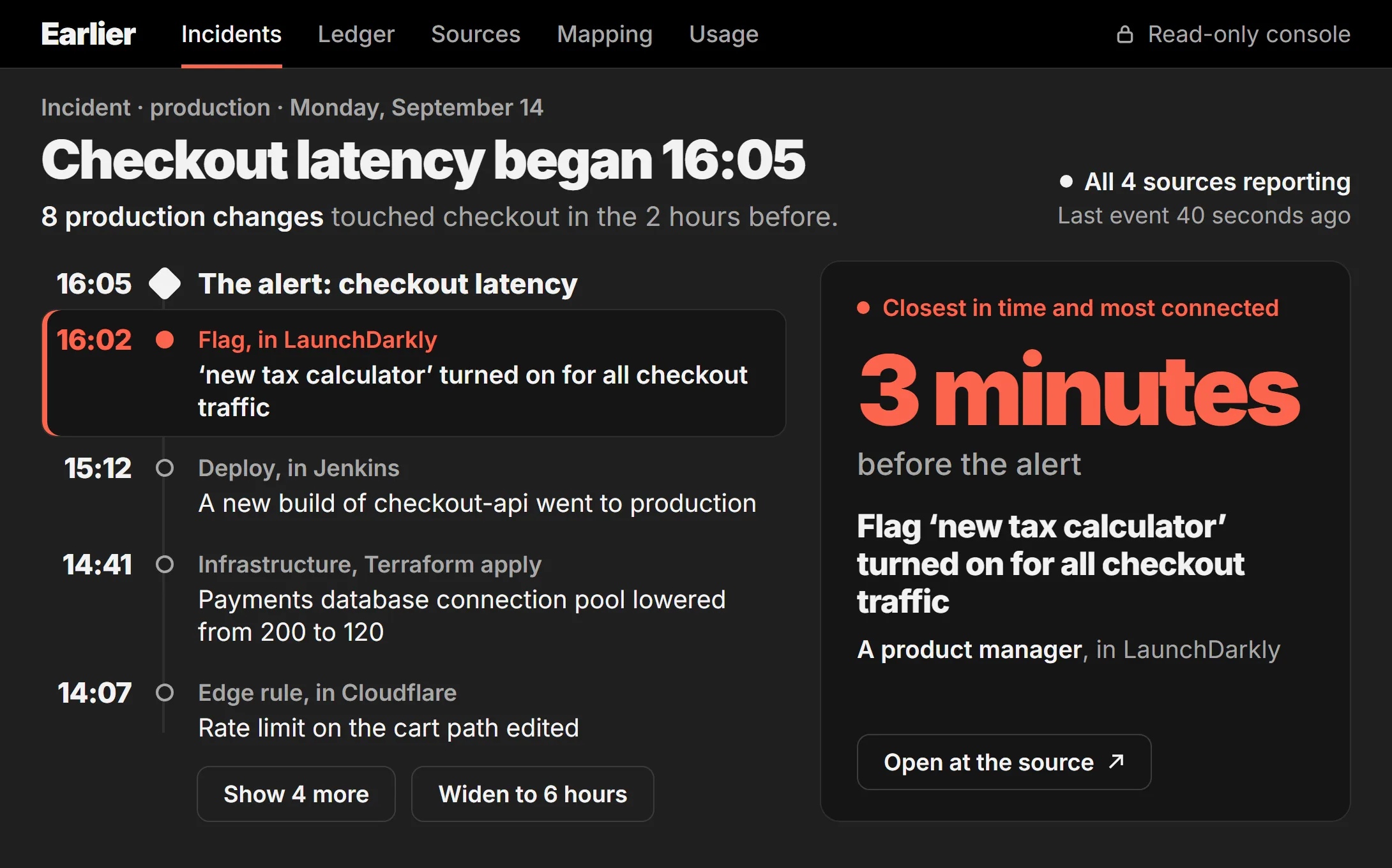
Every change before 16:05, newest first. The flag flipped three minutes before the alert leads the list.
The category sells agents that investigate alerts. The first question on a bridge needs a record somebody kept.
Its models file each change under a service and suggest an order.
The reasonable objection
“We will buy an AI SRE, and it will answer this too.”
It may. Read two of its pages before you wait on it.
Resolve AI investigates an alert before the on-call engineer is paged and builds initial findings. For an enterprise with that problem it is a defensible purchase.
Its integrations page, as of September 2026, marks Jenkins, Terraform, LaunchDarkly and Cloudflare as coming soon.
Its pricing page explains credits and prints no rate, plan or minimum. The customers it names are large enterprises.
- An agent can only reason from the sources it reads
- Those four tools are where your production changes happen
- Resolve AI connects custom tools through APIs and webhooks. Earlier is an API.
What the API returns
Every change from four tools, filed under one clock
Jenkins, Terraform, LaunchDarkly and Cloudflare each keep their own history. Earlier files each change by the minute it took effect, not arrival, in one append-only ledger kept 13 months. Say checkout latency triples at 16:05. Ask what changed, and this comes back.
| Took effect | Kind | What changed | Source |
|---|---|---|---|
| 16:02, 3 minutes before | Flag | ‘new tax calculator’ turned on for all checkout traffic | A product manager, in LaunchDarkly |
| 15:12, 53 minutes before | Deploy | checkout-api went to production | The release pipeline, in Jenkins |
| 14:41, 1 hour 24 minutes before | Infrastructure | Payments database connection pool lowered from 200 to 120 | A platform engineer, Terraform apply |
| 14:07, 1 hour 58 minutes before | Edge rule | Rate limit on the cart path edited | A security engineer, in Cloudflare |
Not a verdict. The list has no cause field. Not editable either. The one removal is a signed redaction that leaves a tombstone.
By 16:20 the bridge is full and “what changed?” has four possible homes. The flag flipped at 16:02 sits in an audit log nobody has open.
One of Resolve AI’s own customer stories describes engineers stitching “what changed” together by hand from deploy pipelines and Terraform events before debugging.
The query is GET /v1/changes with service and onset, 120 minutes back.
The product
What the bridge sees at 16:06
The Slack app and the read-only console sit on the same endpoints. Neither shows anything the API does not return.
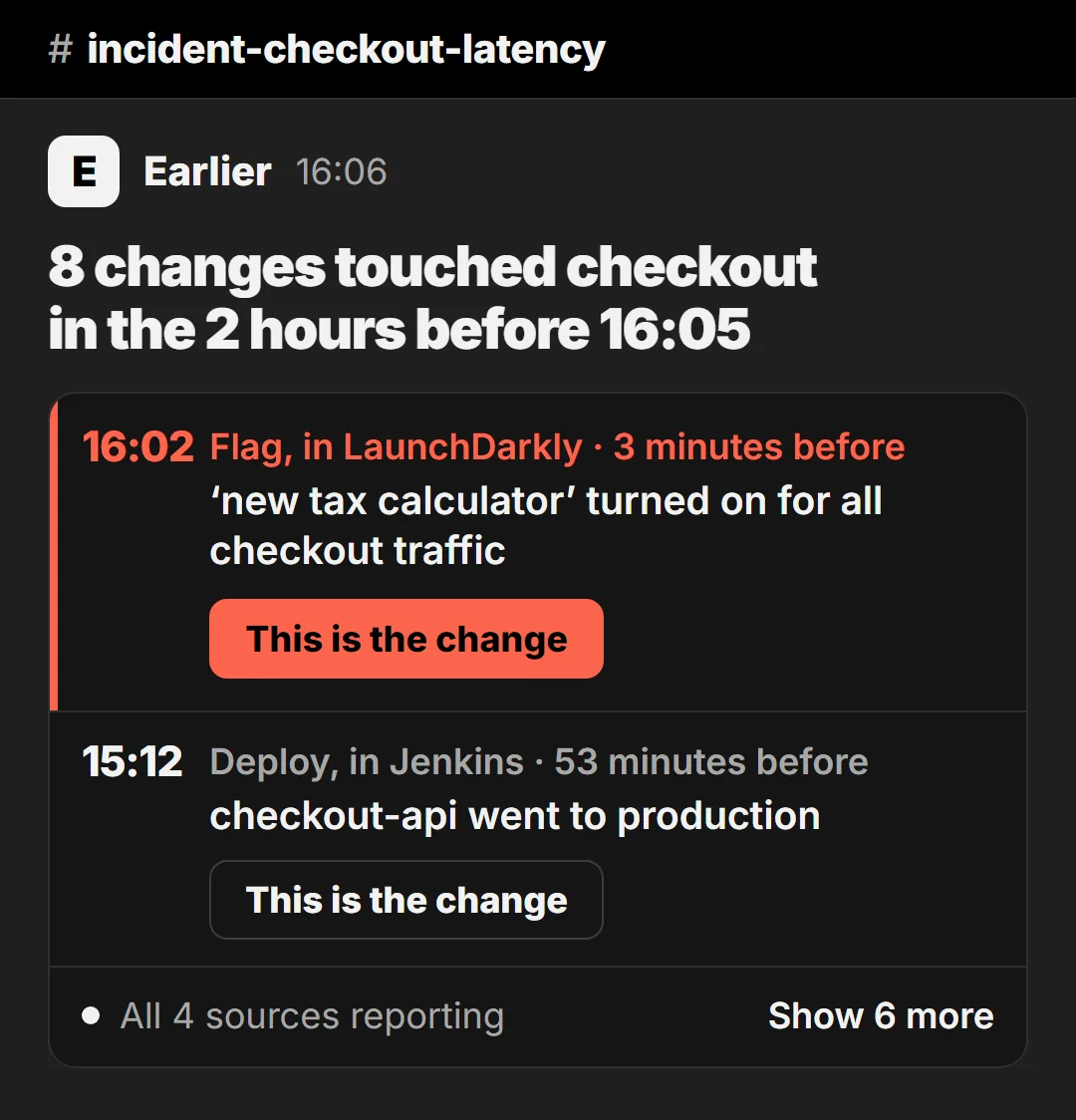
Channel answer
Eight changes before 16:05, posted to the incident’s Slack channel
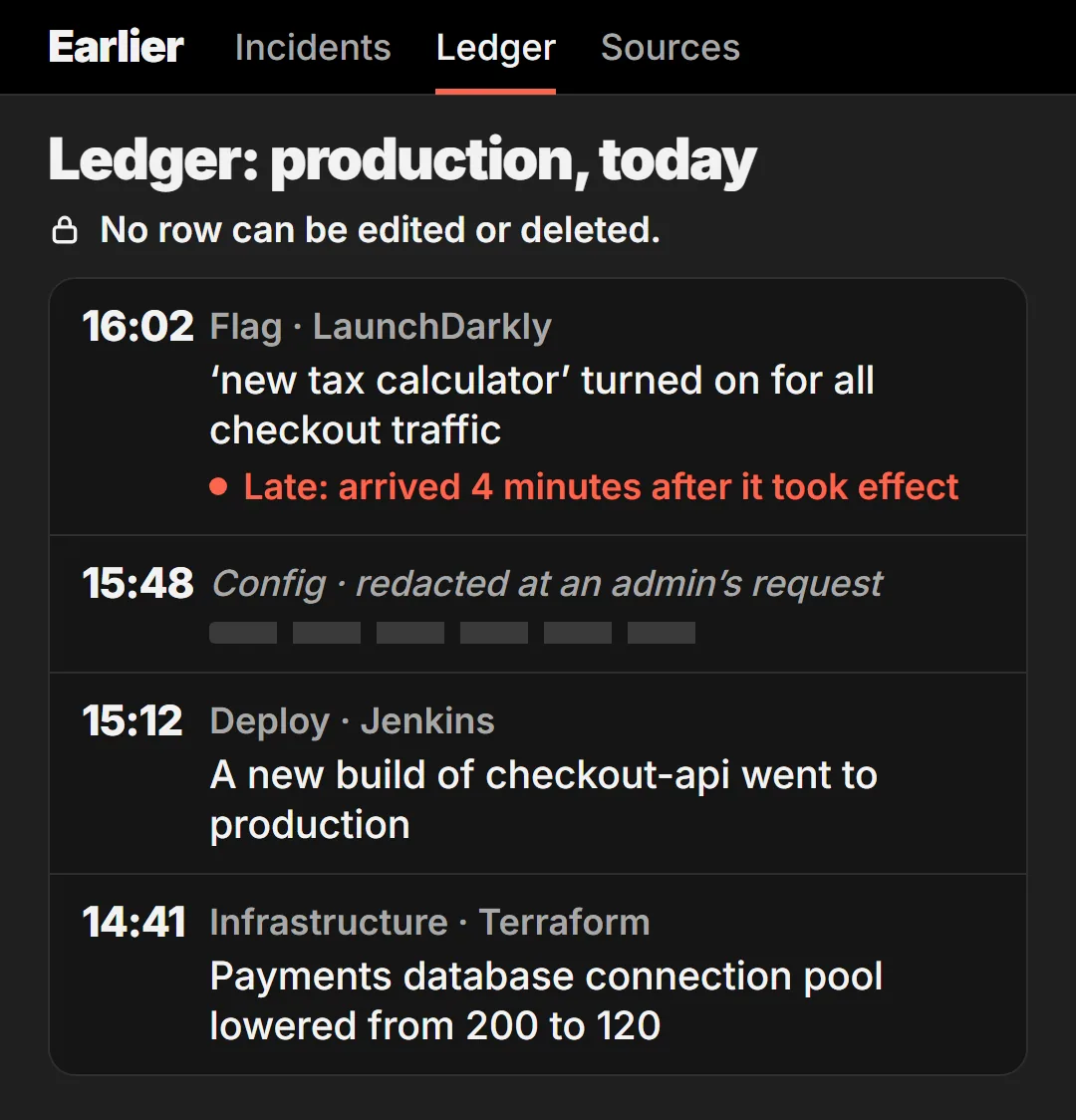
Ledger
Every production change today, with no edit or delete control
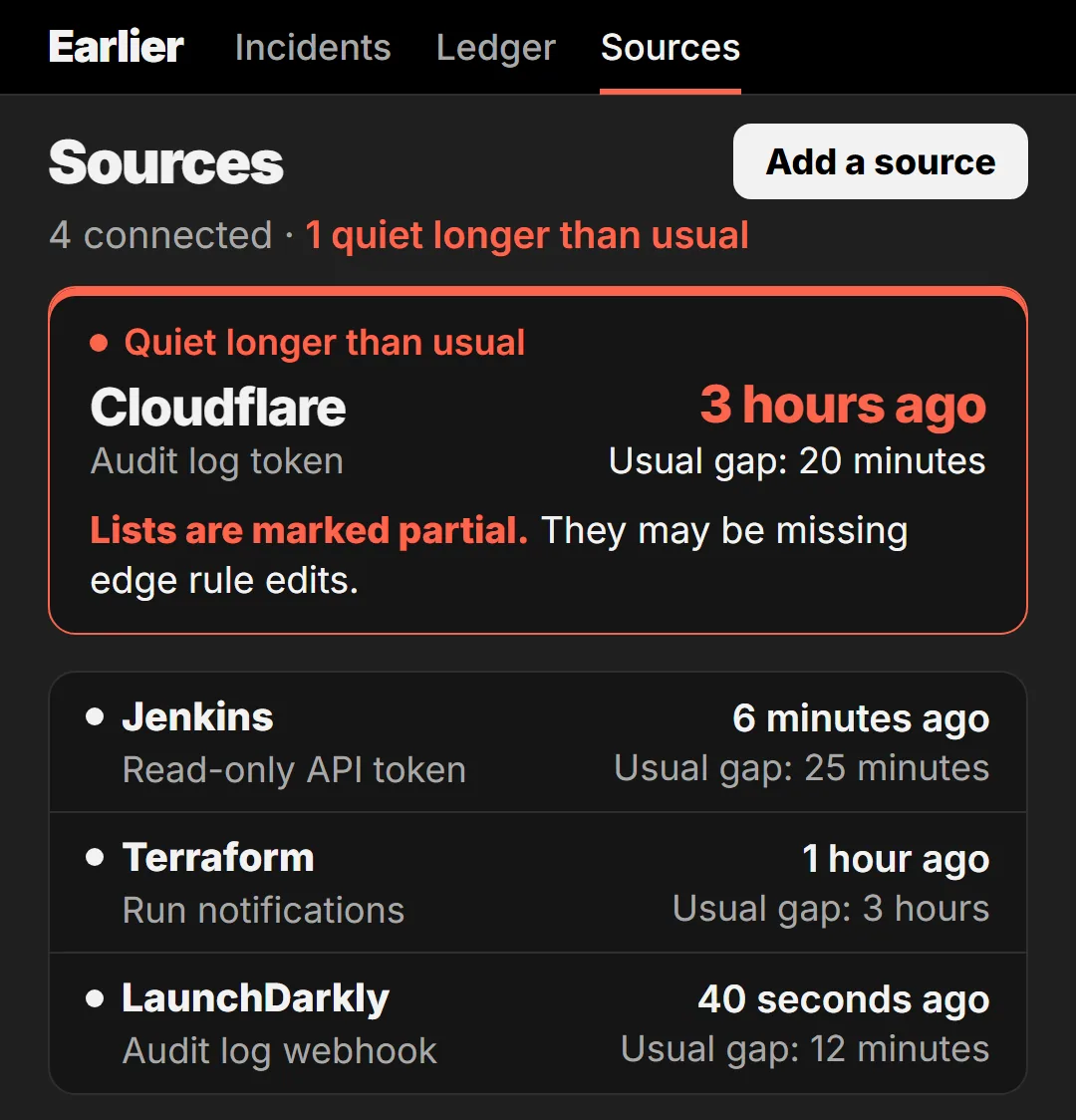
Sources
Each connected source, its last event, and any gone quiet
A record only helps mid-incident if everyone on the call believes it is complete. That includes the entries that embarrass someone.
A rate printed before you sign
$120 per incident where a responder named the change. Otherwise $0.
$120per incident with the change named
- $120 each for incidents 1 to 10 in a month, $90 for 11 to 30, $60 after
- No change named, or the named change was not in the ledger before trouble began: $0
- Sources, events, queries and 90 days of backfill are never billed
- One enterprise’s published account: 20 to 30 engineers on a live bridge, mid-severity incidents past an hour. That is twenty-plus engineer-hours. The fee is $120.
- First three incidents with a change named are free
- Withdraw a naming within 30 days and the charge comes off
Read-only tokens
Earlier finds no cause and rolls nothing back
Hosted only. A poor fit for a team with one pipeline, or for a company under 30 engineers, where a senior engineer’s memory is cheaper.
- in scope01Every change your sources recorded. Deploys, Terraform applies on any provider, Azure included, flag flips, edge rule edits and rollouts.
- in scope02A coverage line on every answer. It says which sources are reporting. A console click or an SSH hotfix that no source recorded stays invisible.
- we don't01No root cause. A buyer who wants an investigator should buy Resolve AI.
- we don't02No Undo button. Every token Earlier holds is read-only. It cannot roll back a deploy or revert a flag.
The response schema
We left the cause field out of the response.
Earlier returns an ordered list. A person names the change.
One confident wrong answer sends a bridge of twenty engineers the wrong way. A list with clock times can be checked against the graph by anyone present.
- Someone still reads eight changes and decides
- Against an agent that announces a root cause, this loses the demo
- If the cause sits sixth, a good memory beats the list
Replay your last three incidents against it.
Leave a name, a work email and your company. If a known cause is missing from the list, the missing source is your finding.
We reply within one business day.
- ✓ We reply with an ingest key and a read key
- ✓ LaunchDarkly is the shortest first source: one webhook URL
- ✓ Jenkins needs an administrator, and someone to mark which jobs are deploys
- ✓ Each source backfills 90 days on save
- ✓ Replay a known incident and check the cause is listed
- ✓ Keys come without a contract. Revoke them to leave.